Scaling Dexterous Manipulation Through Iterative Hand-Object Interaction Generation
Yi Zuo1,2Yingying Wu2,3Zeyuan Chen2Puhao Li2,4 Fang Liu1Licheng Jiao1,*Baoxiong Jia2,*Siyuan Huang2,*
1 Key Laboratory of Intelligent Perception and Image Understanding, Ministry of Education, Xidian University2 State Key Laboratory of General Artificial Intelligence, BIGAI3 Peking University4 Tsinghua University
From human interactions to robot dexterity.Capture. Generate. Improve. ↘
58.03hValid interaction
20,891Motion sequences
219Object instances
77Object categories
30Manipulation behaviors
01 / THE IDEA
More interactions. More objects. More dexterity.
Learning dexterous manipulation calls for continuous, fine-grained hand–object interactions. Capturing every motion for every object is impractical.
DexBeyond brings together a large-scale real-world dataset, a conditional interaction generator, and a self-improving data flywheel. We expand motion diversity for captured objects, then turn proposals for unseen objects into feasible robot interactions—without additional real-world demonstrations.
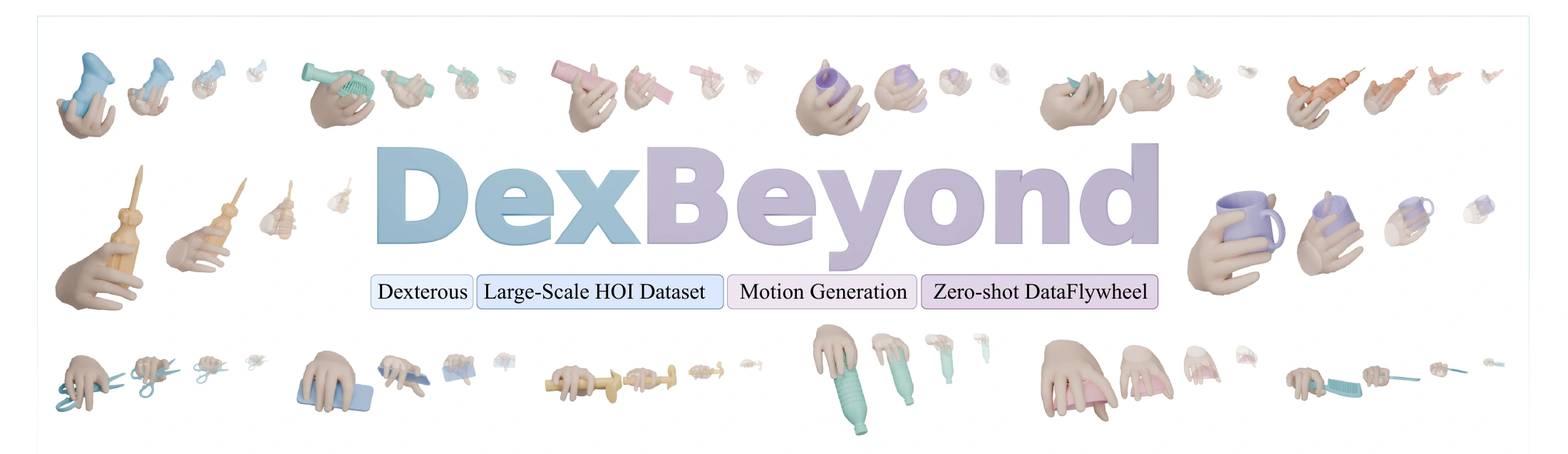
From captured human motion to generated interactions and real-world dexterous manipulation.
02 / DEXBEYOND-D
A foundation for continuous manipulation.
Fine-grained finger coordination, diverse geometries, and synchronized 3D hand and object poses.
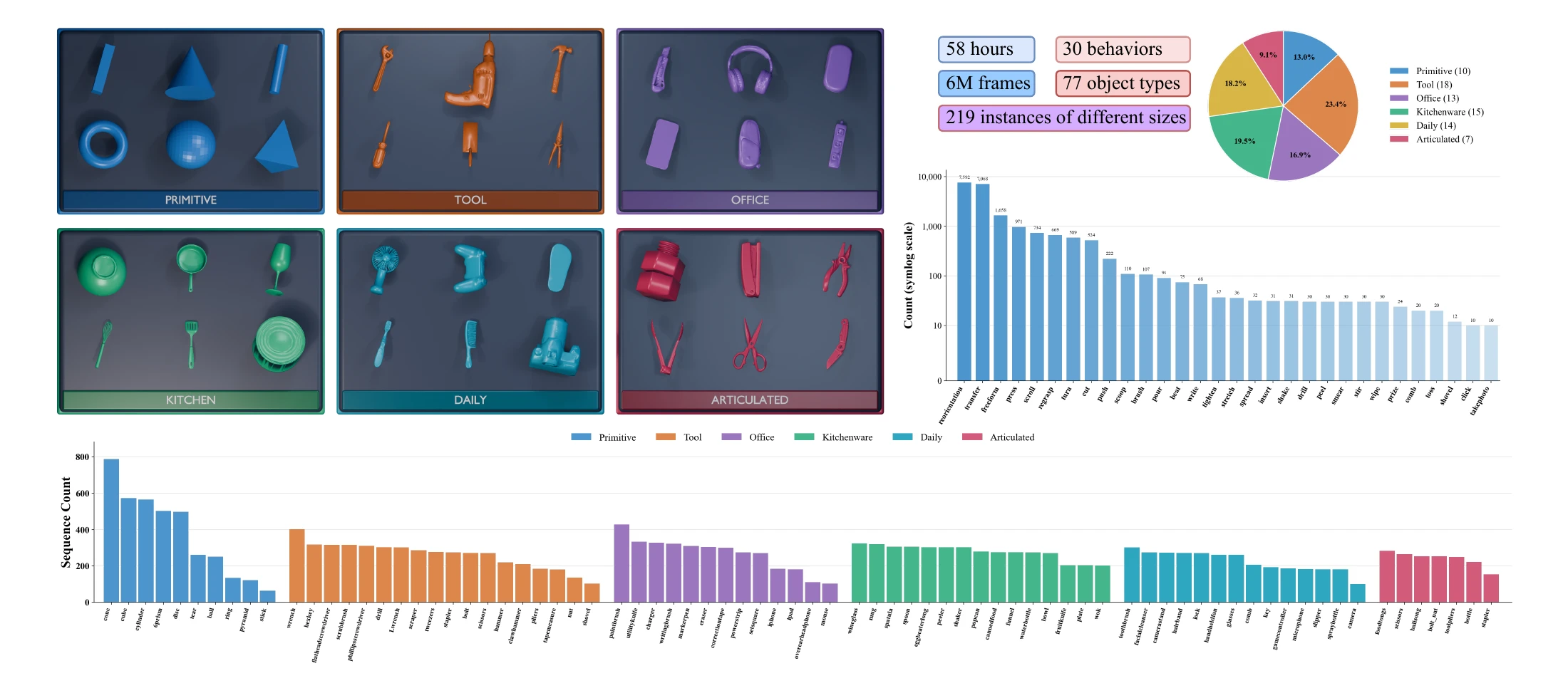
Dataset composition and statistics. Select the figure to view it at full size.
01
Diverse object geometries
Geometric primitives, everyday rigid objects, and articulated or multi-part objects across 77 categories.
02
Continuous in-hand motion
Reorientation, translation, and object-specific functional behaviors under four wrist settings.
03
Synchronized 3D trajectories
6.26 million frames at 30 fps, with reconstructed hand poses, object poses, and corresponding object meshes.
03 / GENERATE & IMPROVE
Beyond the captured data.
Expand how known objects move. Learn to manipulate objects never demonstrated.
DexBeyond-G and DexBeyond-FW: generation conditioned on text and geometry, followed by iterative refinement and execution.
DEXBEYOND-G
Generate richer interactions.
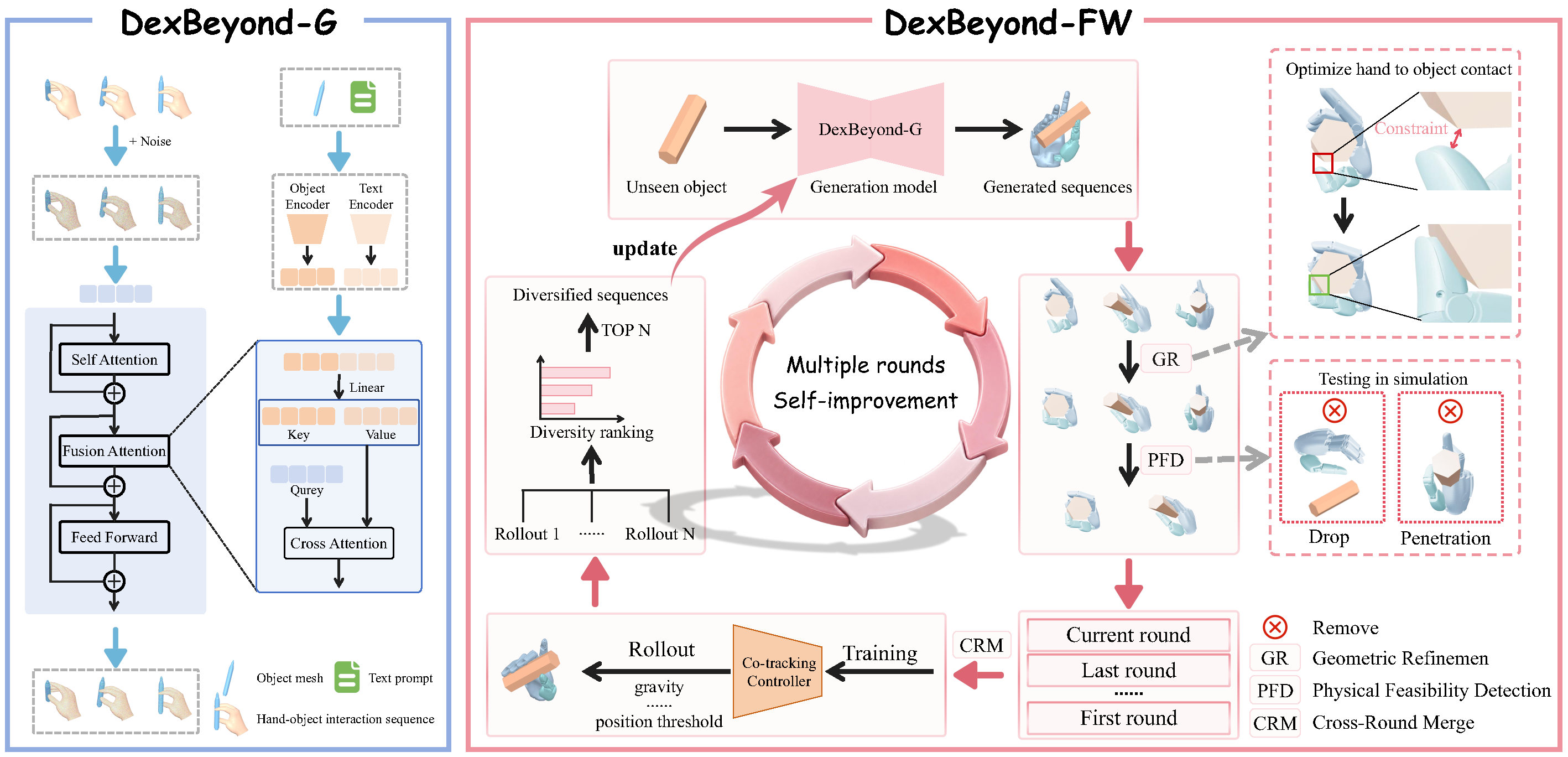
A conditional diffusion model synthesizes continuous hand–object trajectories from object geometry and motion descriptions. Reconstruction, smoothness, and geometric objectives preserve contacts and reduce penetration.
For unseen objects, geometric refinement and physical feasibility detection prepare generated references for controller training. Diverse successful simulation rollouts update the generator for the next round.
Generate → Refine → Execute → Update ↻
04 / EXPERIMENTS
Better data. Stronger manipulation.
Generated interactions improve downstream controller success in simulation and the real world.
SIMULATION10 objects
60.2%→ 69.1%
Mean success rate with captured data versus captured + generated data.
Captured60.2%
+ Generated69.1%
+8.9 percentage points
REAL WORLD5 objects
42.1%→ 54.4%
Mean success rate on the 22-DoF SharpaWave anthropomorphic hand.
Captured42.1%
+ Generated54.4%
+12.3 percentage points
UNSEEN-OBJECT GENERALIZATION
Improvement, round after round.
Across four held-out objects, mean controller success rises over four flywheel rounds. No captured demonstrations from the held-out categories are used.
Round 18.3%
⟶
Round 440.7%
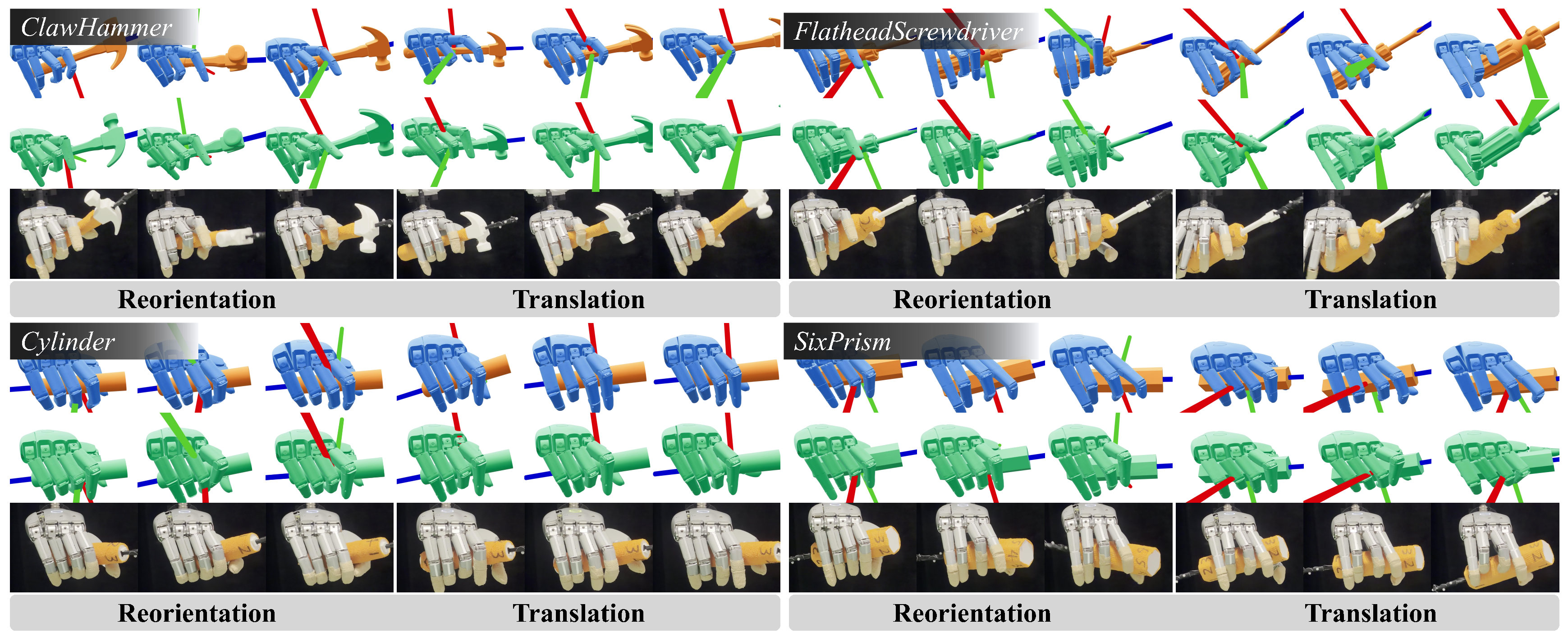
From reference to reality. Reference subgoals (top), simulation (middle), and real-world execution (bottom) for each object.
REFERENCE
Cite DexBeyond.
BibTeX for this work.
@article{zuo2026dexbeyond,
  title={DexBeyond: Scaling Dexterous Manipulation Through
         Iterative Hand-Object Interaction Generation},
  author={Zuo, Yi and Wu, Yingying and Chen, Zeyuan and
          Li, Puhao and Liu, Fang and Jiao, Licheng and
          Jia, Baoxiong and Huang, Siyuan},
  year={2026}
}